Triage Team: 2025 Stats, 2026 Goals
What handling 207 crypto fraud cases taught our response team this year.
As the year comes to a close, we wanted to share a few reflections from the work that Operation Shamrock’s Triage Team has handled over the past year.
While we’ve evaluated and discussed this internally, it’s worth stepping back to look at what the team’s work tells us about where crypto-enabled fraud response stands today and where it needs to go next. And importantly, how you can help.
Scale of the Crypto Fraud Problem
Over the course of the year, our Triage Team worked 207 cases submitted through our website at operationshamrock.org. These cases represent more than $162 million in reported victim losses.
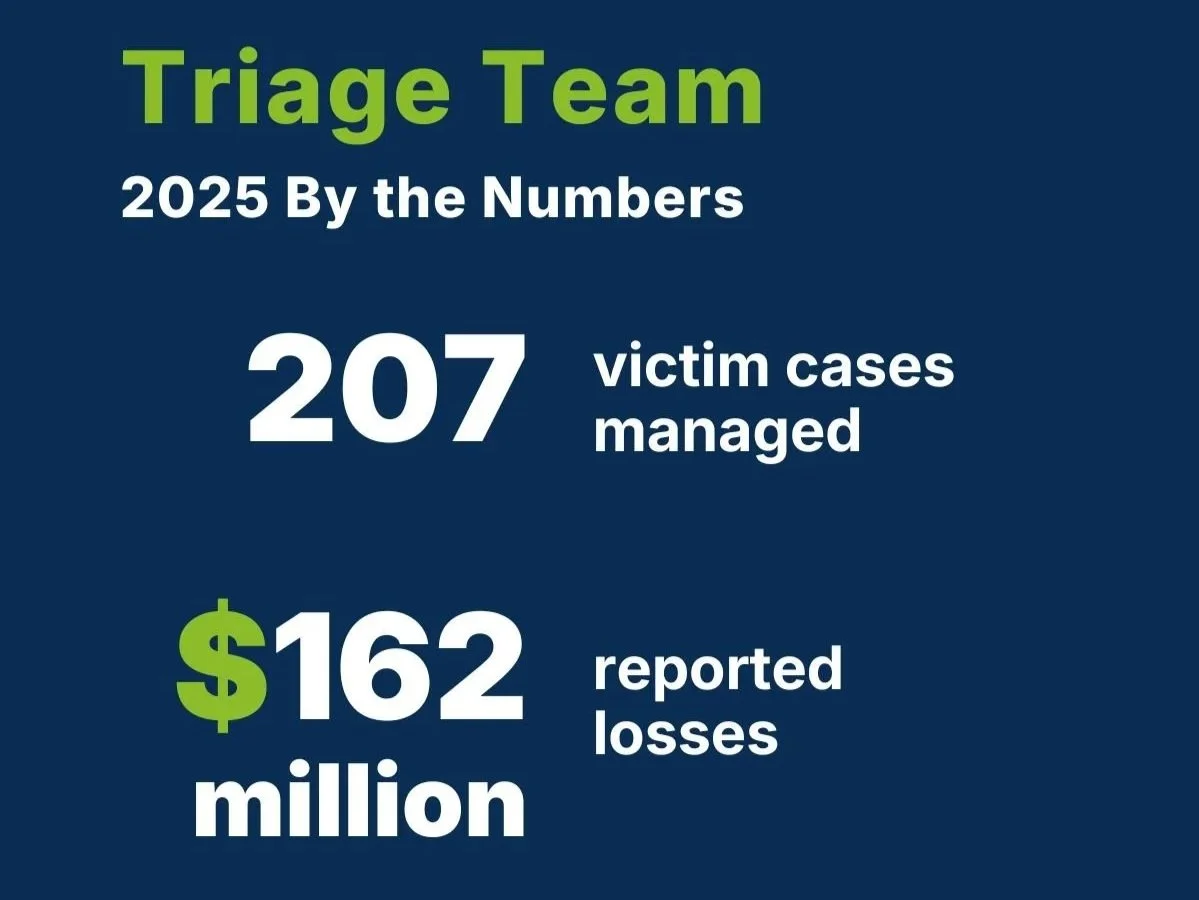
2025 By the Numbers
The Triage Team managed a significant number of cases, addressing substantial victim losses.
Losses are not evenly distributed. A small number of very high-dollar cases drive a disproportionate share of total harm, which is a heavy right-tail distribution that anyone working these cases will recognize immediately.
A Nationwide (and Borderless) Issue
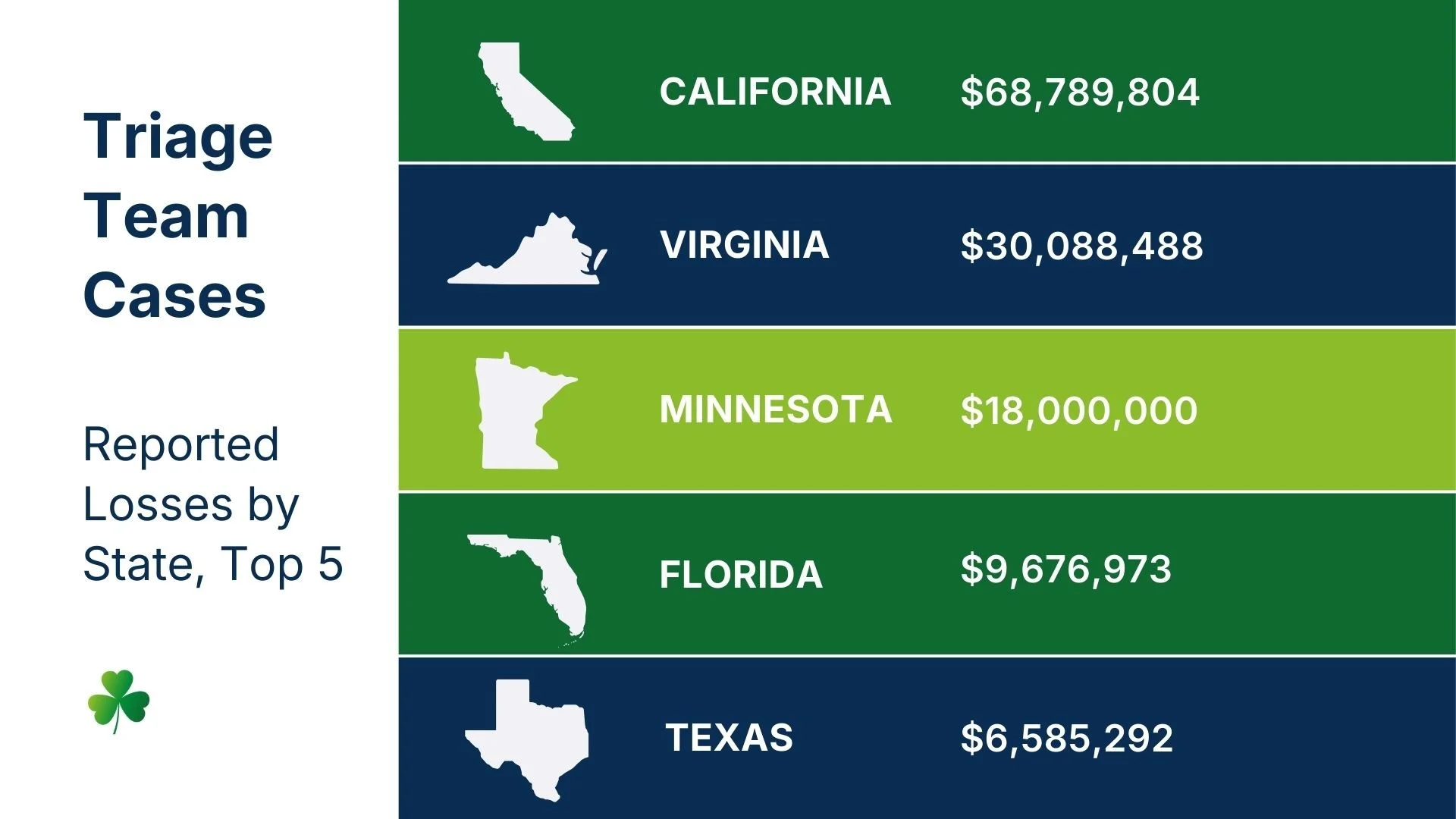
Victims in these cases spanned 38 U.S. states, plus Washington, DC, Puerto Rico, and Canada. A few data points stand out:
California alone accounted for ~42% of total losses
The top three jurisdictions — California, Virginia, and Minnesota — represented roughly 72% of the total loss
States like Virginia and Minnesota showed extreme loss concentrations despite relatively few cases
Fraud is not a localized problem. It is a nationwide — and often international — phenomenon, driven by online targeting, social engineering, and financial rails that move faster than traditional response mechanisms.
Measuring Impact Beyond Recovery
We don’t measure the Triage Team’s impact solely by freeze, seizure, or recovery rates.
In many cases, providing victims with clarity, showing them what happened and how, and identifying where the funds went, is itself meaningful. For victims who have spent months or even years in uncertainty, that closure matters.
That said, we do want to improve recoveries. We’re also realistic about the challenges. Freeze, seizure, and recovery numbers are often fragmented across jurisdictions and services. Without a dedicated case-management system, precision is difficult. These figures are best understood as directional, rather than definitive.
Looking Ahead
Our future focus is not just on growth, but on sustainability and effectiveness. Some of the initiatives we’re working toward include:
Implementing a dedicated case management system
Strengthening existing partnerships and adding new strategic partners
Continuing capacity building with virtual asset service providers (VASPs) and other services
Scaling the team both domestically and internationally
Higher-loss cases generally mean more work, more coordination, and more complexity. Our goal is to ensure investigators are supported, not stretched thin.
Providing victims with clarity, showing them what happened and how, and identifying where the funds went, is itself meaningful.
The Human Factor
None of this work happens in a vacuum. Our investigators handle these cases largely on top of their existing full-time jobs and responsibilities, often in their spare time. A small group of people carried a disproportionate share of the workload this year, and we cannot overstate their dedication.
How You Can Help
It’s surreal to look back at the Triage Team’s inception. We started as a patchwork group of investigators, driven by grit, determination, and a desire to make a difference.
Today, we have a baseline; we know the impact we’re making. And we want to continue demonstrating to law enforcement (especially at the local level) that cryptocurrency can be traced, frozen, and returned to victims.
To build on this year’s work, we need your support. Funding allows us to:
Deploy tools that improve how we process victim reports and manage cases
Offer detectives opportunities for training and certification
Expand our ability to trace, freeze, and ultimately recover funds
We would be deeply grateful if you could contribute financially to support our efforts. If you can’t donate, sharing this post and the Triage Team's work helps more than you might think.
A Closing Thought
Blockchain-enabled fraud (and the response to it) is less about silver bullets and more about systems that support investigators, enable faster coordination, and give victims a better chance at reconciliation and healing, even when recovery isn’t possible.
This year reaffirmed why that work matters. More to come in the new year.
Scott Simons & William J. Jones
Triage Team Leads, Operation Shamrock
Related Stories from Our Blog