The Deepfake Isn’t Always the Most Clever Part of the Scam
Protect yourself by using these tips to recognize manipulation and spot synthetic media.
Guest post from Amit Parmar.
There was a time when spotting a fake photograph meant looking for the “joins.” A mismatched shadow, an awkwardly altered face, perhaps an extra finger. Artificial intelligence has made that detective work considerably harder.
Today, it’s easy to clone a familiar voice, generate photographs, and create videos that make someone appear to say things they never said. Yet the most revealing clue may have nothing to do with the technology. It may be what the person on the screen wants you to do next.
Follow the Emotion, Then the Intent
When a message provokes a strong reaction, pause and ask yourself: What am I being encouraged to feel, believe, or do?
A suspicious video isn’t necessarily one that looks strange. Sometimes it’s one that makes unusual demands.
A celebrity endorses an extraordinary investment.
A manager requests an urgent payment.
A distressed relative needs money immediately and insists on secrecy.
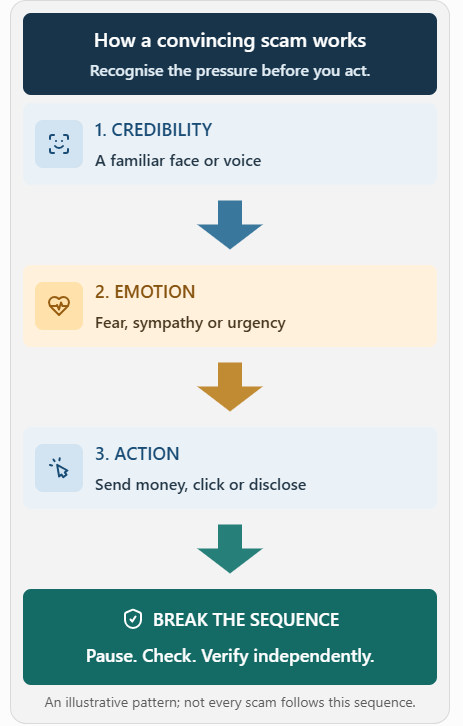
Scam communications use common elements to manipulate emotions.
Different stories, but the same pattern. The familiar face or voice lends credibility, while the story incorporates enough urgency, fear, or sympathy to encourage cooperation, even making hesitation feel unreasonable. By the time they make the request, the fraudster hopes they’ve built an emotional connection strong enough to eliminate doubt.
Cybersecurity expert Dr. Jessica Barker offers a memorable piece of advice: “When emotions are heightened, skepticism should be too.”
Heightened emotion is often precisely what a scammer wants. Fear, excitement, affection, and the desire to help can all push us to act quickly, especially when someone we care about seems to be in trouble.
Even a genuine photograph or recording can accompany a dishonest story. Understanding intent helps us recognize manipulation, whether or not AI is involved.
Why Our Confidence Can Mislead Us
We’re accustomed to trusting our senses, especially when we think we know who we’re talking to. But recognizing someone’s voice isn’t quite the same as establishing who’s speaking.
Research shows that people correctly identified deepfake material about 56% of the time, a result the researchers found wasn’t reliably better than guessing. It’s not just one report. The article “Human performance in detecting deepfakes” examined 56 studies involving more than 86,000 participants.
Encouragingly, the review also found that training and detection aids could improve deepfake recognition rates. Learning what to look for can help, but we shouldn't assume we'll instinctively recognize every convincing fake.
Verify the Call: A Familiar Voice Isn’t Proof
Voice cloning makes impersonation particularly personal. The voice on the call may sound convincingly like someone you know, complete with familiar expressions and mannerisms.
Listening for unusual speech patterns can help, but independent verification is more dependable. If someone unexpectedly requests money or sensitive information, end the conversation and contact them using a number you already know. Don’t trust the incoming caller ID alone; telephone numbers can be spoofed.
Many families agree on a secret phrase, perhaps an obscure quote from a favorite television program, as a verbal password to verify they’re talking to a real family member. It's an extra safeguard, not a replacement for calling back.
The important distinction is that you’re no longer relying on the potentially fraudulent conversation to establish its own authenticity.
Look Closer: Small Details Matter
AI-generated images and videos can be remarkably convincing, but they’re rarely perfect. Knowing what to look for still matters, especially when several unusual details appear together in the same image or video. For example:
Watch the mouth. Do the lips match the words? Does the expression fit the emotion? Poor synchronization can suggest manipulation.
Look beyond the face. Check hands, jewelry, reflections, and background objects. Pay attention to details that change shape, flicker, or disappear between frames.
Notice movement. Unnatural blinking, awkward head movements, or briefly distorted facial features may be revealing.
Listen carefully. Cloned voices sometimes contain unusual pauses, inconsistent pronunciation, or oddly flat emotions.
None of these signs are conclusive. Poor lighting and video compression can produce similar effects, while sophisticated fakes may contain no obvious mistakes. The clues are useful, but their absence isn’t proof of authenticity. But if something doesn’t feel right, it’s worth exploring further.
Check the Source: A Little Detective Work
A dramatic photograph or video deserves a few simple checks before you believe it or share it. Here are four things you can do:
Search the image. Save a photograph or take a screenshot, then open Google Lens using the camera icon in Google Search. Upload the image to look for earlier appearances, different captions, or its original context. Another option is TinEye.
Investigate the video. Pause at a distinctive moment, take a screenshot, and reverse-search it. Journalists at Agence France-Presse (AFP) co-developed a free InVID-WeVerify browser extension that extracts still frames from videos and searches them.
Check the date and place. Look for street signs, landmarks, or recognizable buildings, and compare the location with a tool like Google Maps Street View. Old footage presented as breaking news can mislead even when the recording itself is genuine.
Look for AI labels. Some platforms mark content as ‘AI-generated’ or ‘Made with AI.’ However, not all synthetic media is labeled, so the absence of a warning doesn’t mean it’s real.
Remember, too, that several websites repeating the same claim don’t necessarily confirm it independently.
Trust Is Worth Protecting
The strongest protection against a deepfake may be to move away from “seeing is believing,” and follow a habit we already use in other parts of life: Verify something important before committing to it.
We confirm bank details, question unexpected bills, and seek a second opinion when the stakes are high. A familiar face or voice in digital communication can no longer be exempt from that same reasonable scrutiny.
This has a human side, too. Fraudsters exploit qualities we naturally value in ourselves and others: trust, kindness, loyalty, and a willingness to help. The answer isn’t to become less trusting or less generous, but to recognize when someone may be manipulating those instincts to hurry a decision or action.
If a loved one genuinely needs help, calling them back is an act of care, not suspicion. If a colleague makes an unusual financial request, following established channels protects both of you.
AI will continue to improve, making it even more important to distinguish recognizing someone from establishing who they really are.
We don’t need to abandon trust. We need to take steps to ensure it’s earned.
Amit Parmar is a fraud and cybersecurity intelligence leader with over 20 years’ experience in global banking, specialising in cybercrime, financial fraud and emerging threats. His work focuses on AI-enabled cybercrime, deepfakes and digital trust, translating complex threats into practical insights that help organisations and individuals stay protected.
Related Stories from Our Blog