I Walked Into an Abandoned Scam Compound
Erin West returned to Cambodia to see if reality matched the media reports about scam compounds being shut down.
Erin West, Founder, Operation Shamrock
A man waved us through the gate.
That was it. No challenge, no questions. Just a wave, and suddenly I was standing inside an abandoned scam compound in Phnom Penh, Cambodia — one of the facilities that, until roughly two weeks earlier, had housed thousands of human trafficking victims forced to run cryptocurrency fraud operations around the clock.
I’m a former prosecutor. I have read the survivor accounts. I have spoken at length with people who survived these places and came home with stories that were almost too terrible to believe. I had prepared myself for what I might find.
I was not prepared for what I found.
What Scam Compounds Look Like from the Outside
Before I describe the inside, you need to understand what you’d see standing on the street. Because the answer is: everything. These compounds are not hidden.
They are massive structures — multiple buildings within a campus enclosed by cement walls that rise two stories or more, topped with barbed wire. The only entry point is a single controlled gate. There are bars on the windows. If you have ever seen a prison, the visual vocabulary is the same. The message is the same: People go in, but they don’t leave.
What’s remarkable — and important — is that this is not concealed from the surrounding community. Neighbors live alongside these compounds. Shops operate near them. The Cambodian landscape has simply absorbed them, the way a city absorbs any persistent feature of its environment. They became, as I described after my first trip in 2025, the industry of Cambodia. Visible, open, and enormous.
On that first trip, my colleagues Nathan Southern and Lindsay Kennedy drove with me for a thousand miles across the country. We expected to find the known hub of Sihanoukville. We didn’t expect to find compounds like this everywhere — walled in, guarded, under construction — as if the industry were still expanding, confident in its permanence.
Inside: Trafficking Survivor Stories, Confirmed
Walking through the abandoned compound in Phnom Penh, I carried in my mind every account I’d heard from survivors. And one by one, what I saw confirmed what they had told me.
The scam rooms themselves had heavy, industrial metal doors with external padlocks. The workers inside could be locked in. This is not a detail I had been told to look for. I didn't know about the padlocks until I saw them. And then I thought of every survivor who had mentioned feeling trapped, who had described the inability to leave their workstation, and I understood in a way I hadn’t before that the word trapped was not a metaphor.
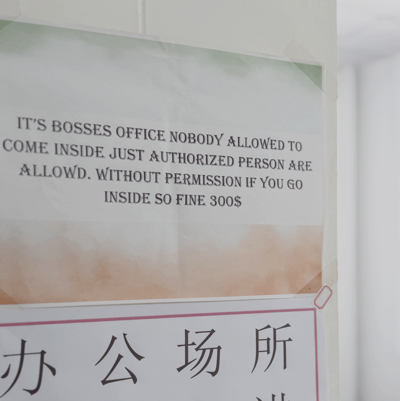
The walls throughout the compound had signs warning people about fines for infractions.
On the walls were signs that told the economic story of this place more clearly than any report I’ve read.
Do not touch the air conditioning unit. Penalty: $300.
Do not enter the manager's office without permission. Penalty: $300.
One survivor had told me that misspelling a word in a message to a victim could result in a $100 fine. Walking through that compound, looking at those signs, I understood exactly how the math worked: It’s impossible for workers to earn their way out. The system was designed so that fines would always exceed wages. The labor was, functionally, free.
The game is stacked against them. There is no way to make money — and no way to leave. By design.
Green Screens and Manufactured Identities
Along the walls of the scam rooms, I saw large green screens. This detail stopped me cold.
The people running these operations don’t just pretend to be romantic partners or investment advisors. They impersonate authorities. Survivors have described being shown fake FBI agents, fake Australian police officers, fake financial regulators — all produced from rooms just like the ones I was standing in. The green screens make it possible to manufacture any backdrop, any uniform, any official-looking environment.
If you’ve ever received a call from someone claiming to be from a government agency — asking about your accounts, warning you of suspicious activity, urging you to move your funds to a safe location — there’s a good chance that call came from one of these green screen rooms with a locked door and a fine schedule posted on the wall.
The Detail that Haunts Me
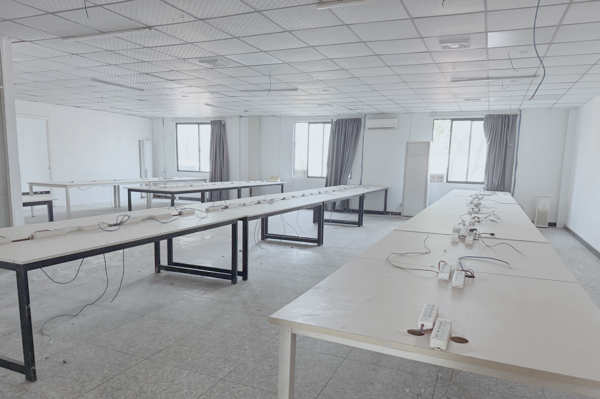
In two separate rooms, I found mattresses. Dozens of mattresses, each roughly an inch thick, stacked in neat piles. Beside them were thousands of chairs, stacked and waiting. They had not been removed. They had not been destroyed. They had been stacked — carefully, deliberately — in a way that said, “We will be back.”
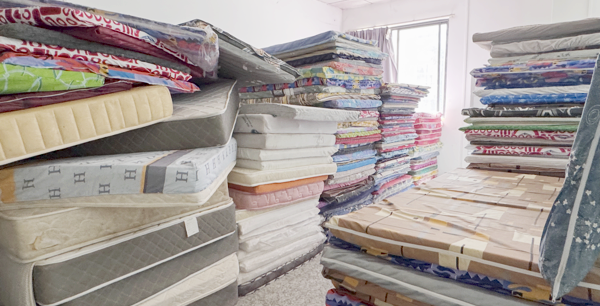
A room full of mattresses in an abandoned scam compound.
This is the detail I want policymakers and journalists to hold onto. An abandoned compound is not a closed compound. The infrastructure is intact. The layout is unchanged. The locks still work. What’s missing is the workforce — and workforces, in this industry, are replaceable. Human trafficking networks that feed workers into these facilities are still operating. The demand-side infrastructure — the scam scripts, the cryptocurrency channels, the international money laundering networks — didn’t disappear when the government began its crackdown.
What I walked through felt less like the aftermath of a shutdown and more like a pause. A held breath. A business that had sent everyone home while the inspection was underway, and was waiting to see whether the inspectors would leave.
Why What I Found Matters for Accountability
The physical infrastructure of these facilities is documentation. The fine schedules on the walls are evidence of labor exploitation. The locked scam rooms are evidence of confinement. The mattresses and chairs are evidence of workforce scale. The green screens are evidence of impersonation schemes. None of this should be left to deteriorate or be quietly dismantled before investigators with proper authority can document it systematically.
I went into that compound as a former prosecutor. I came out thinking about evidence.
As unbelievable as their stories sometimes seem, survivors of these compounds have been telling the truth. Every account I verified that day — details I had not prompted, details I discovered independently — matched what they described. Their credibility matters for prosecution. Their testimony matters for justice. And the physical spaces they described, for now, still exist.
The question is whether anyone with the authority and the will to act will get inside before the chairs come back off the stacks.
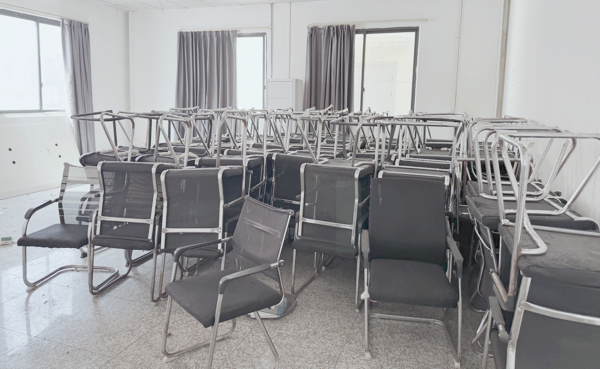
The compound is abandoned, but it is truly shut down, or are the stacks of chairs just waiting for people to come back?
Related Stories from Our Blog