Joint Economic Committee Statement for the Record: Combating Scams
Operation Shamrock Founder Erin West’s March 2026 statement for the record for the U.S. Congress Joint Economic Committee.
STATEMENT FOR THE RECORD OF
Erin West
Founder and Chief Executive Officer, Operation Shamrock
Former Deputy District Attorney (26 years), Santa Clara County, California
BEFORE THE
JOINT ECONOMIC COMMITTEE, UNITED STATES SENATE
ON
“Combating Scams”
March 25, 2026 — Washington, D.C.
Prepared for hearing: “The Rising Global Scam Economy: Modernizing Federal Approaches to Protect Americans from Foreign Fraudsters,” March 25, 2026
Thank you to the Chairman, Ranking Member, and distinguished Members of the Joint Economic Committee for holding this hearing and for the opportunity to submit this statement for the record. The subject of this hearing — combating scams — is not a consumer protection footnote. It is one of the most urgent economic crises facing the United States today, and it demands the attention of this Committee.
My name is Erin West. I spent 26 years as a prosecutor with the Santa Clara County, California District Attorney’s Office, where I worked with the REACT Task Force — an elite state-funded cybercrime task force — and became one of the first local prosecutors in the country to specialize in cryptocurrency-enabled fraud. I left that position to found Operation Shamrock, a 501(c)(3) nonprofit coalition of more than 2,000 law enforcement professionals, financial institutions, technology companies, and victim advocates, unified around a single mission: to educate, mobilize, and disrupt the transnational organized criminal networks responsible for the pig butchering epidemic.
I have testified before the Subcommittee on National Security, Illicit Finance, and International Financial Institutions of the House Committee on Financial Services. I have briefed congressional offices and federal agencies. I have traveled to Southeast Asia — to Cambodia, Thailand, and Myanmar — three times in the last twelve months to conduct field investigations inside scam compound territory. I have helped rescue a human trafficking victim held inside one of those compounds. I host the Stolen podcast, where survivors, investigators, and policymakers share their stories. I have personally spoken to more than 15,000 people about this crisis in a single year.
I come before this Committee not as a witness describing a distant problem. I come as someone who has stood inside the physical infrastructure of the criminal enterprise stealing American wealth — and who has watched it expand in real time while we debate our response.
I. THE SCAMDEMIC IS AN ECONOMIC EMERGENCY
America is experiencing the single worst financial attack on individual citizens in its history. I call it the scamdemic — not for rhetorical effect, but because the word captures what is actually happening: a mass-casualty financial event spreading household by household, decimating savings, destroying retirement security, and transferring generational wealth out of the American economy at a scale that demands a national response.
The numbers are staggering — and they are getting worse every year. According to the FTC’s Consumer Sentinel Network 2024 Data Book, Americans reported losing $12.5 billion to fraud in 2024 — a 25% increase over 2023. Investment scams, the primary category encompassing pig butchering, accounted for $5.7 billion of that total, a 24% increase over the prior year. Critically, this surge was not driven by more people reporting fraud. The number of reports remained flat. What changed is that the percentage of reporters who lost money jumped from 27% to 38% in a single year. Scammers are not reaching more people. They are destroying more of the people they reach.
But reported losses are only the beginning of the story. The FTC’s own December 2025 report to Congress on protecting older adults estimated that actual total fraud losses across all ages in 2024 — accounting for chronic underreporting — may be as high as $195.9 billion. Nearly $200 billion. Annually. In the United States alone.
For older Americans, the picture is particularly devastating. The FTC’s report to Congress found that fraud losses among adults 60 and older skyrocketed from $600 million in 2020 to $2.4 billion in 2024 — a 300% increase in four years. That $2.4 billion in reported losses represents only the tip of the iceberg; the FTC estimates real losses for older adults alone could reach $81.5 billion. Investment scams were the single largest loss category for this age group, with social media as the most common point of contact. The cases driving the surge are not small-dollar nuisances — 68% of aggregate reported losses by older adults came from individuals who lost more than $100,000. These are people losing their retirement. Their homes. Their children’s inheritance.
The global picture is even more alarming. Nasdaq Verafin’s 2026 Global Financial Crime Report — produced in collaboration with Celent and Oliver Wyman and released this month — found that global illicit financial activity has surged by $1.3 trillion since 2023, reaching an estimated $4.4 trillion in 2025. Fraud scams and bank fraud combined account for $579.4 billion of that total, growing at a compound annual growth rate of 19.3%. That growth rate is more than twice the rate of the broader global economy. Making matters worse, 90% of financial crime professionals surveyed for the report reported an increase in AI-driven attacks at their institutions over the past two years — criminals are weaponizing artificial intelligence to scale their operations, eliminate language barriers, and make their scams more convincing than ever. This is not a problem that is stabilizing. It is accelerating.
The economic damage extends far beyond any single figure. Pig butchering does not steal pocket money. It is engineered to consume the entirety of a victim’s financial life. Scammers methodically map their targets’ full financial picture before they strike — retirement accounts, home equity, savings accumulated over decades. Baby boomers are transferring generational wealth not to their children, but to Chinese organized crime. That wealth leaves the American financial system entirely. It does not recirculate. It does not create jobs. It funds criminal infrastructure overseas.
This is not fraud as Congress has traditionally understood it. This is systematic capital extraction at war-level scale. The numbers the FTC is now reporting to this Congress — $12.5 billion reported, potentially $195.9 billion actual — are not consumer protection statistics. They are economic emergency indicators. The Joint Economic Committee is exactly the right forum to examine what that means for American households, for financial system integrity, and for national security.
II. HOW THE SCAM WORKS — AND WHY IT WORKS SO WELL
Pig butchering — a translation of the Chinese phrase sha zu pan — is the name the perpetrators use. They will fatten a victim like a pig before slaughter, taking everything, snout to tail. Understanding the mechanics is essential to understanding why this crisis is so hard to stop.
The scam typically begins with a misdirected text message or a connection request on a social media platform. A stranger — almost always presenting as attractive, successful, and romantically available — builds a relationship over days or weeks. The investment pitch follows naturally: the target’s new companion shares a supposed investment secret, a cryptocurrency platform that has made them wealthy. They offer to help.
Here is the critical sequence that follows:
The victim opens an account at a legitimate U.S. cryptocurrency exchange, providing full Know Your Customer information under their own name.
At the scammer’s direction, the victim converts their dollars into a stablecoin — typically USDT/Tether — still held in their own exchange wallet.
The victim is then instructed to move the funds from the legitimate exchange into a fraudulent “investment platform.” This is the moment of theft. Thousands of these fake platforms are live on the internet at any given time.
The victim sees a convincing dashboard showing spectacular gains. Their “investment” doubles within days. The platform is entirely fake. The money is moving through mule accounts down the blockchain.
When the victim attempts to withdraw, they are hit with a fabricated “tax” — typically 25% of the account’s stated value, payable in new funds only. Some victims take out home equity loans or high-interest personal loans to pay it. Some realize at this point they have been scammed. Others pay and are hit with additional fabricated fees until there is nothing left.
The reason this scam works with devastating consistency is psychological precision. Victims are not naive or careless. They are targeted specifically because they have assets worth taking. The relationship that precedes the financial fraud is real to them. The shame of being deceived in love, compounded by the shame of financial loss, is exactly what the perpetrators count on to suppress reporting. The enemy has deliberately chosen a crime type that the victim will not want to disclose.
Let me be specific about the human cost. A 30-year-old software engineer in Santa Clara County — I will call him Evan — lost his entire savings in a pig butchering scheme. My task force recovered a significant portion through blockchain tracing and we realized we had a blueprint. We’ve made it our mission to teach and train other law enforcement how to recover assets in a similar manner.
Another victim, the sole financial support for his immigrant parents, told the scammer via text that if he lost his money he would “suicide in secret.” The scammer’s response: “Trust me. Your money is safe.” He lost everything. He was hospitalized. Two years later, he remains on disability leave.
I have spoken with the adult children of three different men who took their own lives after being victimized by pig butchering schemes — in Michigan, California, and Maryland. These families did not know why their fathers died until they found the evidence in their digital lives. The suicides continue at uncomfortably regular intervals. They are not slowing down.
III. WHAT I SAW ON THE GROUND IN SOUTHEAST ASIA
In February 2025 and again in February 2026, I traveled to Cambodia to conduct field investigations alongside journalists Nathan Southern and Lindsay Kennedy of the Eyewitness Project. I also traveled to Thailand and Myanmar twice as part of my work with the United States Institute of Peace Senior Study Group. I’ve been inside raided compounds in the Philippines as a guest of the government. What I witnessed over these trips constitutes some of the most important evidence I can place before Congress about the true state of this crisis.
Trip One: The Scale Nobody Was Prepared For
When I first arrived in Cambodia in February 2025, I expected Sihanoukville. The port city had been widely reported as the heart of Cambodia’s scam compound industry — casino towers built by Chinese organized crime, converted during COVID into fortified scamming operations staffed by human-trafficked workers. I was prepared for what I had read.
I was not prepared for what I found everywhere else. Over the course of a thousand miles of driving across Cambodia, Nathan, Lindsay, and I discovered that the scam compound infrastructure was not concentrated in Sihanoukville. It was nationwide. Compound after compound — massive, multi-building facilities enclosed by two-story cement walls topped with razor wire, single controlled-access gates, bars on windows — in cities, in rural areas, under construction. Everywhere.
Sihanoukville itself was staggering. Chinatown — the tech park at its center — is the scale of a college campus. Multiple city blocks of buildings housing eight people to a room, all enclosed behind walls that are not meant to keep outsiders out so much as to keep workers in. When I stood outside those walls, what I saw was not an illicit enterprise hiding in the shadows. It was an industry. Open. Obvious. Under construction. Growing.
I came home from that trip with an understanding of the gravity of this crisis that I had not fully had before. The compounds I saw were not operations at the margins of Cambodia’s economy. They were the economy. USIP and the UN Office of Drugs and Crime have estimated that revenue from the scam industry comprises more than 40% of the combined GDP of Cambodia, Myanmar, and Laos. What I saw with my own eyes confirmed that estimate is not an exaggeration.
Trip Two: The Crackdown That Isn’t
I returned to Cambodia in February 2026 with a specific question: Is the crackdown real? In the months prior to my trip, the Cambodian government — under international pressure — had made highly publicized moves against the scam compound industry. The U.S. indictment of kingpin Chen Zhi, his subsequent extradition to China, the U.S. and UK sanctions against the Prince Group, and visible actions like marching workers out of compounds had generated significant media coverage suggesting that Cambodia was finally getting serious.
I came with healthy skepticism. I have watched crackdowns before. I know how they work.
In Phnom Penh, the crackdown appeared genuine. The Prince Group headquarters — a crown jewel of a criminal empire — had a legal notice on the window. The building was empty. Prince Plaza, where on my first trip I had been surrounded by eight men — some armed, some in Cambodian police uniforms — who demanded I delete video I had taken, now had its gate down. I was able to enter freely. I walked through an abandoned scam compound in Phnom Penh, waved in by a guard at the gate. What I saw inside confirmed everything survivors had told me.
The interior of that compound was chilling. Fine schedules were still posted on the walls: “Do not touch the air conditioner. Fine: $300.” “Do not enter the boss’s office. Fine: $100.” Scam workers had been told that misspelling a word would cost them $100. There was no way to earn money. The game was designed to extract labor for free. The rooms where scamming was conducted had metal doors that bolted from the outside — workers were locked in while they worked. I saw green screen walls, suggesting workers had been made to impersonate law enforcement officials, including possibly U.S. federal agents. It was filthy, dark, and horrifying.
But here is what told me everything I needed to know: every mattress in the compound — thin, inch-thick slabs — was stacked in two rooms, ready to be placed back on beds. Thousands of chairs were stacked and waiting. This was not a closed business. This was a business on pause.
A local woman selling water near the darkened Chinatown complex in Sihanoukville said it plainly when Lindsay asked her in Khmer whether it was closed. She looked at us as if the question was obvious. “No,” she laughed.
She was right. And I have the evidence to prove it.



Mansion 8: The Industry Is Moving, Not Ending
The most significant thing I witnessed on my second trip was not the performance of a crackdown in Sihanoukville. It was what was happening a few miles away and three hours from Phnom Penh on a dirt road near the Vietnamese border.
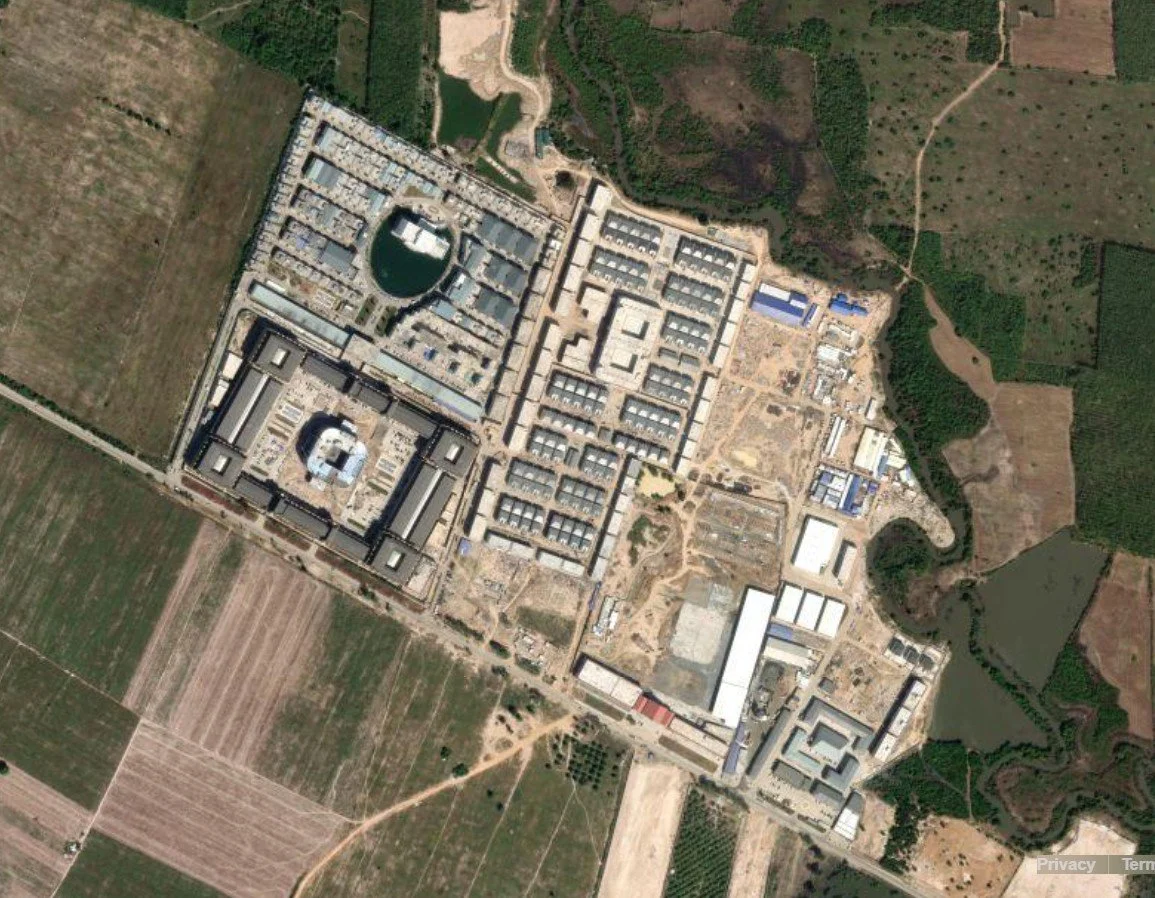
We came upon the compound we were looking to find – Mansion 8. It appeared to still be in operation, active and with people going in and out of the complex. Its size and structure are complex and massive, operating with caged windows, and guard-controlled entry and exit.
We found not a shuttered operation but a city in the middle of active construction.
On the one road in and one road out, we passed convoy after convoy of Alphards — the black-windowed minivans that are the vehicle of choice for moving scam compound workers. At one staging area, I counted between 60 and 100 Alphards waiting. Workers were being moved — not released. Relocated.
As we followed the boulevard past Mansion 8 and into what can only be described as a fortified city under construction, we saw the full scale of what is being built there. Using Apple Maps, I was able to identify four distinct compound structures.
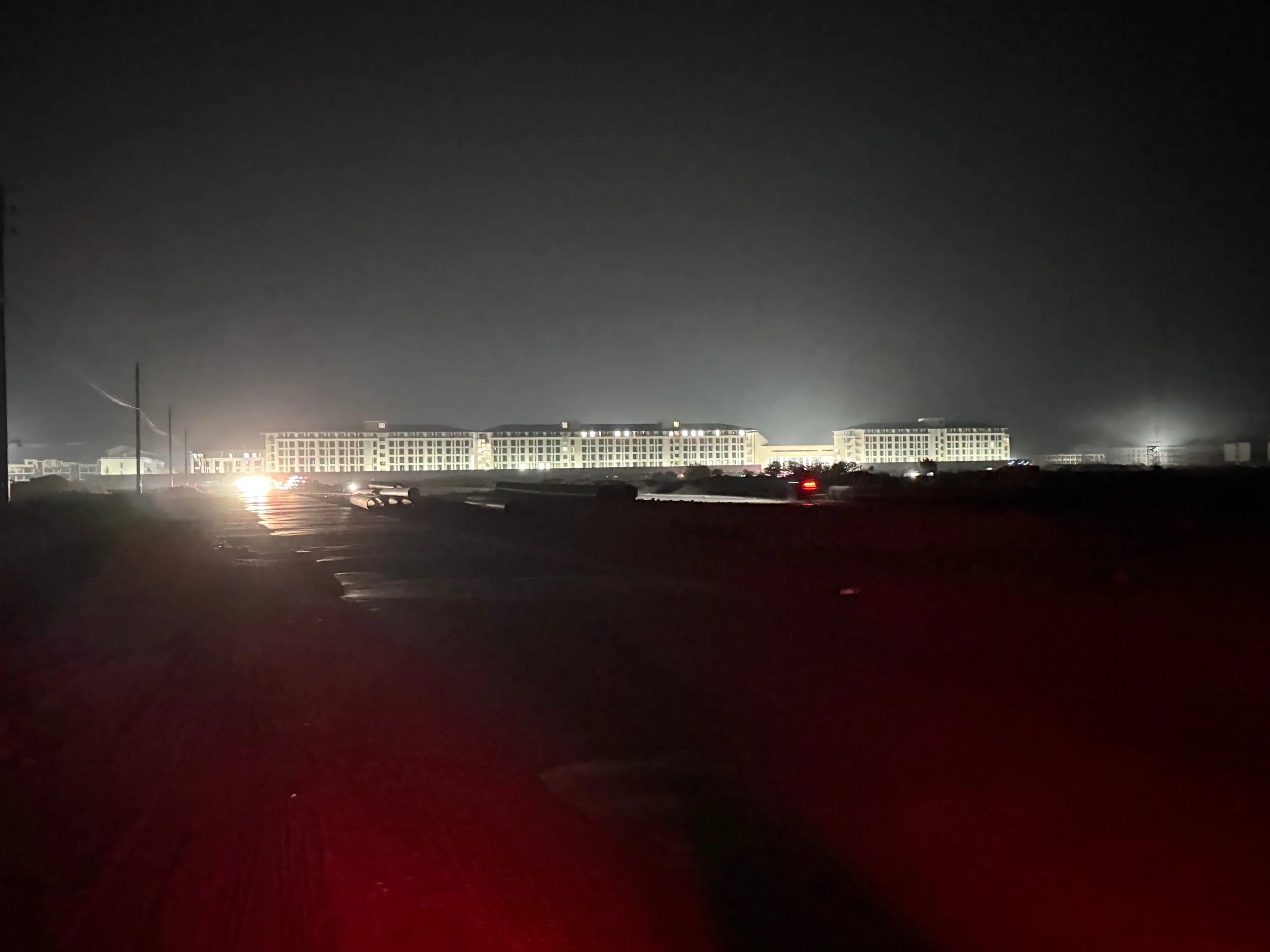
One appeared to be at least a half-mile long. There were more buildings behind it. The construction around it was ongoing, with a concrete factory, raw materials staged, roads being developed, and lighting infrastructure already in place. Infrastructure being built at a scale I had never seen before.
It was fully operational. Glowing in the darkness.
While we were there, food stall operators near the compound told us that police had shown up for several consecutive days, gone in, and come back out without taking action.
The conclusion I drew, and that I place before this Committee plainly: the Cambodian crackdown is a sleight of hand. They have cleaned up what we knew to look at. While attention was focused on Sihanoukville and Chinatown, the industry was moving — to more remote locations, less accessible to journalists and investigators, better protected from intervention. The compounds on Prince land outside Sihanoukville were active and busy. Mansion 8 was growing. The industry is not ending. It is relocating and expanding.
Furthermore, the scale of what I witnessed at Mansion 8 is beyond the capacity of conventional law enforcement to address. I spent 26 years executing search warrants. I know what it takes to safely execute a warrant on a four-bedroom house in San Jose. What exists at Mansion 8 is not a building. It is a city. Raiding it would require a military-scale operation. No police department — in Cambodia or anywhere else — is equipped for this. We have allowed this to grow for so long that we are now genuinely out of our depth.
Shakilu: A Human Trafficking Rescue from Inside a Compound
One of the reasons I traveled to Cambodia in February 2026 was personal. In the summer of 2025, I received a message from a man named Shakilu, a Ugandan national who had been trafficked into a scam compound in Cambodia. He had found my contact information and reached out via WhatsApp — to me and to his brother in Uganda — asking for help. He told me he knew his exact location and could provide coordinates. He told me his compound was actively scamming American victims at that moment.
Over the following months, Shakilu described to me in detail the violence being perpetrated against him. He was being tortured. He was resistant to scamming and his bosses saw him as a problem. I was unable to find a way to get him out. My colleagues Nathan and Lindsay drove to his location. They could not reach him — the compound he had escaped from was massive, heavily guarded, still under construction.
At the end of August 2025, his messages stopped. For four months — September, October, November, December — I believed he had been killed.
In mid-January 2026, I heard from him again. He had escaped the compound on his own and was in a taxi Cambodia, trying to figure out what to do next. I came to Cambodia to meet him and assist him in navigating the bureaucracy involved in getting him back home.
In parallel, Nathan and Lindsay had been working with another group of human-trafficked victims from Uganda and Kenya held at Mansion 8. Those individuals were released from the compound and are currently in a shelter awaiting repatriation. Their freedom is a direct result of the kind of cross-sector, boots-on-the-ground collaborative work that Operation Shamrock is designed to support and expand.
Shakilu’s story — months of contact, silence, fear, survival — is not exceptional. It is representative. There are thousands of people like him inside compounds right now, staffing the criminal enterprise stealing American wealth. Their labor is coerced. Their wages are zero. Their freedom is conditional on compliance. This is not fraud in the abstract. It is a supply chain of enslaved human beings producing a product: the financial destruction of American families.
IV. OPERATION SHAMROCK: WHAT THE WHOLE-OF-SOCIETY RESPONSE LOOKS LIKE
Operation Shamrock’s cross-industry coalition is dedicated to combating pig butchering and transnational organized crime in Southeast Asia. We are a 501(c)(3) nonprofit with more than 2,000 active members spanning law enforcement, financial institutions, cryptocurrency exchanges, technology companies, NGOs, and victim advocacy organizations. Our mission — Educate. Mobilize. Disrupt. — is a framework for the kind of coordinated response this crisis demands.
The Crypto Coalition, which predates Shamrock’s formal founding, began in October 2022 with 85 law enforcement members who showed up for a single webinar on pig butchering. It now has more than 2,000 active members. We have trained hundreds of credit unions, community banks, and major financial institutions on pig butchering typologies and front-line intervention. We have created resource guides for bank tellers. We have built a victim triage system — in partnership with TRM Labs — that routes newly victimized individuals to trained blockchain investigators in real time, when recovery is still possible. We have increased media coverage through reporting done by the New York Times, CNN, ABC, CNBC, and 60 Minutes Australia.
In January 2026, we held the 4th Annual Crypto Coalition Conference in St. Louis, with former Binance executive Tigran Gambaryan — himself a victim of a hostage crisis at the hands of a foreign government — as keynote speaker. We have briefed congressional offices. We have contributed to legislative efforts to strengthen KYC and AML requirements for cryptocurrency
swapping services. We have presented to state securities regulators, federal prosecutors, and the National District Attorneys Association.
I say all of this not to catalog our accomplishments, but to make one point clearly: the whole-of-society response this crisis requires is not theoretical. We have built a version of it. We know what it takes. And we know that what we have built — without federal coordination, without dedicated funding, without a national strategy — is not sufficient for the scale of the problem.
V. WHAT CONGRESS MUST DO
The Joint Economic Committee has a unique mandate: to examine the economic health of the nation and make recommendations to Congress. The scamdemic is an economic emergency. And for the first time, there are signs that the executive branch understands the scale of what we are facing.
On March 6, 2026, President Trump signed an Executive Order titled “Combating Cybercrime, Fraud, and Predatory Schemes Against American Citizens.” It is a serious document. It directs the Attorney General to prioritize prosecutions of cyber-enabled fraud schemes against transnational criminal organizations. It requires an action plan within 120 days identifying the TCOs responsible for scam centers and proposing solutions to dismantle them. It establishes a dedicated operational cell within the National Coordination Center. It directs the Secretary of State to impose real consequences — sanctions, visa restrictions, foreign assistance limits, expulsion of complicit foreign officials — on nations that tolerate these predatory operations. And it directs the Attorney General to recommend a Victims Restoration Program to return seized and forfeited funds directly to victims.
This is the framework Operation Shamrock has been asking for. On paper, it is exactly right.
But executive orders are not self-executing. An action plan is not an action. A 120-day deadline produces a document, not a dismantled compound. The question before this Committee is not whether the Administration has the right instincts. The question is whether Congress will provide the oversight, the funding, and the legislative tools to make this executive order real. Without that, it joins a long list of well-intentioned directives that produced reports and left victims waiting.
Here is what Congress must do to ensure the March 6 EO delivers results — and to fill the gaps it leaves.
1. Demand Accountability on the 120-Day Action Plan
The March 6 EO requires the submission of a comprehensive action plan identifying the TCOs responsible for scam centers within 120 days — a deadline that falls in early June 2026. Congress must require that this action plan be delivered to the relevant committees, not just to the President. Members should demand a public briefing on its contents, including specific TCOs identified, specific compounds targeted, and specific diplomatic consequences planned or already applied. An action plan that sits in the Executive Office of the President without congressional oversight is not accountability.
2. Fund What the EO Directs But Cannot Pay For
The March 6 EO is an authorization without an appropriation. It directs agencies to act but provides no new funding to act with. Congress must appropriate dedicated resources for the NCC operational cell, for DOJ prosecutorial capacity targeting pig butchering TCOs, and for the CISA training and technical assistance to state, local, tribal, and territorial partners that the EO explicitly calls for. Directing law enforcement to fight a $4.4 trillion global criminal enterprise without funding the fight is not a strategy.
3. Build a Singular, Unified Victim Reporting System
Victims currently navigate a maze of federal reporting portals — IC3, FTC, CISA, FinCEN, and more — with no coordination between them, no acknowledgment of receipt, and no reasonable set of expectations. The result is exhausted victims who give up and a data set that dramatically undercounts the problem. Congress must mandate and fund the development of a single reporting portal that ingests all relevant data, routes cases appropriately, and provides victims with a human acknowledgment and realistic expectations. Without accurate data, we cannot size our response correctly.
4. Fund State and Local Law Enforcement
The March 6 EO directs CISA to support state and local partners. That mandate requires investment. When a pig butchering victim calls their local police department — which is almost always the first call they make — they are met with an officer who has no training, no tools, and no time. The vast majority of local law enforcement cannot help a pig butchering victim. Not because they do not want to, but because they have been given nothing to work with. Congress must fund targeted training and tools for state and local law enforcement. The Crypto Coalition has demonstrated the appetite for this kind of support. It exists. It needs federal investment.
5. Pass Legislation That Slows the Money and Enables Recovery
Speed is the enemy of recovery. By the time a victim realizes they have been scammed, the money has moved down the blockchain at a pace that outstrips any law enforcement response. The March 6 EO directs the AG to recommend a Victims Restoration Program — but that program can only work if there are funds to restore. Congress must pass sensible legislation that creates friction in high-risk transactions — slowing wire transfers and crypto movements that match pig butchering typologies — and that gives law enforcement new statutory tools to freeze, seize, and return funds before they disappear. Every day without this legislation is money that cannot be recovered.
6. Apply Diplomatic Pressure Grounded in Ground Truth
The March 6 EO directs the Secretary of State to impose consequences on nations that tolerate these schemes — sanctions, visa restrictions, trade penalties, expulsion of complicit officials. Congress must hold the Administration to that mandate with teeth. The Cambodian government is performing a crackdown for an international audience while the industry migrates to more remote and defensible locations. I have seen this with my own eyes. Congress must ensure that U.S. diplomatic engagement is grounded in verified ground truth — not government press releases from Phnom Penh. Foreign assistance and trade relationships must be conditioned on
genuine, verified action against the scam compound infrastructure. Performative crackdowns must not be rewarded with diplomatic normalization.
7. Treat This as the National Security Threat It Is
The March 6 EO recognizes that foreign regimes provide “willing or tacit state support” to these criminal networks. That is a national security acknowledgment, not just a law enforcement problem. The USIP Senior Study Group reached the same conclusion: these networks now directly threaten the national security of the United States and its allies. I have seen the physical infrastructure of that threat. It is not a collection of shady websites. It is a network of fortified compound cities, some the size of small towns, operating with state protection in countries where the rule of law has been purchased. Dismantling this infrastructure requires resources, coordination, and political will at the level of a national security response. The executive branch has now said so in writing. Congress must match that urgency with action.
CONCLUSION
I have been saying for three years that we are at crisis level and we must act. I am still saying it, because it is still true — and the crisis has grown. Billions more dollars have been stolen from American households. More families have been destroyed. More human beings have been trafficked into compounds to do the stealing. And the compound infrastructure, far from being dismantled, is relocating and expanding into territory that is even harder to reach and even harder to raid.
The enemy is organized, funded, strategic, and patient. They have chosen their crime type deliberately. They have built their infrastructure carefully. They have purchased the protection they need. They are not stopping.
The question before this Committee — and before Congress — is whether the United States will finally organize a response commensurate with the scale of the attack. Not a partial response. Not a siloed response. A whole-of-society, whole-of-government response with a leader, a strategy, and the resources to execute it.
We cannot afford another year of watching this grow.
Thank you for the opportunity to submit this statement for the record. I am available to brief Members and staff at any time and welcome the opportunity to provide additional information, documentation, or testimony as needed.
Respectfully submitted,
Erin West
Erin West
Founder and Chief Executive Officer, Operation Shamrock
www.operationshamrock.org
Related Stories from Our Blog