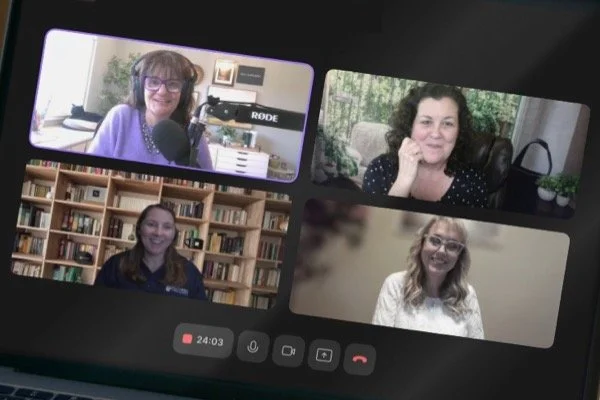
Dr. Martina Dove uses a real-life romance scam story to explain the psychological strategies scammers use to manipulate their targets.
Episode 56: In a follow-up to our interview with Kirsty Guest, Dr. Dove exposes the manipulation techniques Kristy’s scammer used against her: credibility-building, intermittent reinforcement, manufactured crises, isolation, and self-blame.
Being scammed isn’t about a victim’s intelligence; it’s about how effectively the scammer uses psychology to manipulate them. Together, Erin, Dr. Dove, and Kirsty explore how rational thinking becomes impossible under sustained anxiety, what family members can do to support victims, and why empathy is what ultimately helps victims break free and begin to heal.
The techniques I’m seeing now are so much more manipulative, so much more harmful.— Dr. Martina Dove
5 Ways Scammers Manipulate their Victims
1. Scammers operate from a deliberate, staged playbook. Dr. Dove breaks the manipulation into clear phases. She uses Kirsty’s experience to show how her scammer first built trust, then shifted toward control through flattery, guilt, and shame. Each stage prepares the victim for the next, with credibility cues — like a convincing but fake bank account — designed to override any warning signs before they appear.
2. Scammers leverage a cycle of anxiety and relief to create a powerful behavioral loop. Withdrawal periods when the scammer temporarily breaks off communication trigger genuine anxiety and self-blame, while the scammer’s return produces intense relief. This cycle mirrors known persuasion techniques, which condition victims to crave the relationship’s highs while tolerating its lows.
3. Scammers use a person’s past trauma as a tool for control. Kirsty’s 16 years in a coercive marriage meant the scammer's abusive patterns — silence, blame, criticism — felt familiar rather than alarming. He used the information she shared about her history against her to accelerate the manipulation.
4. Scammers isolate their targets subliminally, not through direct demands. Rather than explicitly telling Kirsty to cut off her family, the scammer created a bubble where “it's just between us,” making outside relationships feel irrelevant. The isolation deepened her dependence and reinforced the relationship’s perceived importance.
I remember him saying. “It’s just between us. No one else will understand how you’re feeling right now and what we’re going through.” — Kirsty Guest
5. Scammers rely on victims not being able to see the pattern from inside the scam. Being in a constant state of fear, anxiety, and fight-or-flight impairs executive function and rational judgment. Dove stresses that vigilance and intelligence don’t protect against this — the manipulation works precisely by clouding judgment at a primal level.
The first thing that a person will do if you come on strong is pull away from you…. The scammer is grooming them and persuading them that friends and family wouldn’t understand.— Dr. Martina Dove
Break the Cycle with Support, Not Confrontation
Kirsty’s sister and parents helped her recover by listening without judgment rather than criticizing her choices. Dove emphasizes that direct confrontation pushes victims toward the scammer, while empathy and patience create space for victims to reach their own realization. And she emphasizes that the scam target isn’t the only victim; their families and friends are also harmed and deserve support.
Scroll down for: Guest Bio - Chapters - Useful Links - Sponsors - More Stolen
Who Is Dr. Martina Dove?
Dr. Martina Dove is a research and product strategy consultant and a scam psychology subject matter expert. Her work focuses on the human side of fraud, exploring the factors that can make people more vulnerable to scams, as well as the persuasion techniques fraudsters use to manipulate their victims.
With a background in user experience research and product strategy, Martina helps organizations design more effective fraud-prevention strategies by better understanding user behavior, decision-making, and points of vulnerability.
Martina is especially passionate about destigmatizing fraud victimization and empowering people to recognize and resist scammers’ tactics. She is committed to fighting fraud through education and awareness, helping individuals spot even the most sophisticated scam techniques. She has published a book on fraud psychology, actively supports fraud prevention non-profits, and regularly writes for industry blogs on fraud and consumer protection.
Episode Chapters
00:00 How Scammers Use Psychology to Manipulate
04:39 Understanding Manipulation Techniques
10:02 Kirsty's Personal Journey and Vulnerability
13:12 Trust and Control in Scams
17:24 The Emotional Rollercoaster of Scamming
21:17 The Impact of Isolation and Self-Blame
29:22 Isolation, Manipulation, and Control
32:00 Understanding Anxiety and Emotional Turmoil
34:49 The Role of Family Support in Recovery
36:50 Victim Blaming and Stigma of Scams
39:58 Empathy and Kindness in Supporting Victims
44:19 Healing and Moving Forward
Useful Links
Book: The Psychology of Fraud, Persuasion and Scam Techniques by Dr. Martina Dove
Subscribe to Stolen for straight truth, survivor-centered storytelling, and bold conversations about the scamdemic and the people fighting back. Find Stolen on YouTube, Apple Podcasts, Spotify, Amazon Music, and other major podcast platforms.
Sponsors of Stolen

BioCatch prevents financial crime by recognizing patterns in human behavior, continuously collecting 3,000 anonymized data points – keystroke and mouse activity, touch screen behavior, physical device attributes, and more – as people interact with their digital banking platforms. With these inputs, BioCatch's models reveal patterns that distinguish the criminal from the legitimate.

Scamnetic is a leader in AI-powered scam detection and prevention, protecting individuals, businesses, and financial institutions from digital scams. With solutions like KnowScam and IDeveryone, Scamnetic delivers real-time scam insights, identity verification, and intervention. Restoring trust, reducing losses, and empowering organizations to safeguard customers in an increasingly complex digital world.
Recent Episodes of Stolen