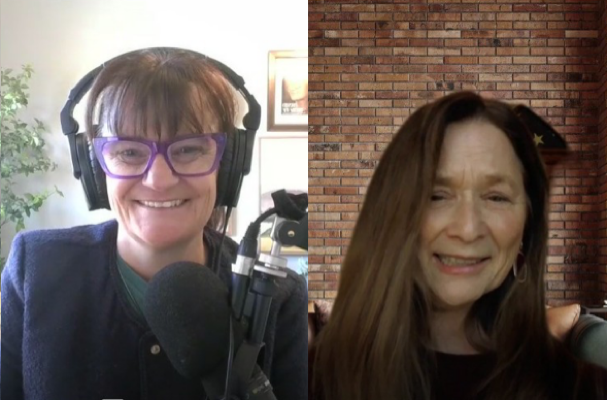
Scam survivor Mary Handeland returns to Stolen to talk about how she investigated her own case and provided US and Nigerian law enforcement with the evidence.
Episode 78: Mary Handeland is, by her own account, conservative, careful, and hard to rattle. She was also targeted by a crypto-linked fraud that began as a romance scam and quickly became something else.
When you’re sending money, you send it in increments, and you don’t see the big picture. You don’t really realize the magnitude of what’s happening. — Mary Handeland, scam survivor
Mary returns to Stolen to update Erin West about her case. Mary turned a flood of scammer messages, email headers, and fake documents into a case file thorough enough to hand to investigators on two continents. In their conversation, she and Erin confront a harder question: What happens when a target does nearly everything right and the system on the receiving end still has no idea where to put it?
Prefer the audio version? Find Stolen on Apple Podcasts, Spotify, Amazon Music, and other major platforms.
Three Takeaways from Mary’s Experience
1. Urgency, not belief, is the scammers’ weapon. Mary explains that her scammers never needed her to believe their story, only to react to it in the moment. They kept her in a loop of manufactured crises with no time to think. And because she paid them in increments, she never grasped the full magnitude until the total finally stopped her.
All they need you to do is act. That is the entire goal: to not allow you to have time to think through what’s happening. — Mary Handeland
2. Investigating her own case gave her perspective — and evidence. By running the scammers’ messages, email-header metadata, and tracking links through AI, Mary spotted manipulation patterns, traced IP addresses to Nigeria, and produced four reports without sending the scammers more money. She is clear she isn’t advocating that anyone stay in contact with scammers. She is describing how analysis moved her from reacting to investigating.
3. Even a strong evidence file still hits a wall. Reports to the FBI, U.S. Secret Service, and legal attachés drew silence. A detective in a nearby jurisdiction, connected through Operation Shamrock, traced the crypto and identified four suspects using data she’d collected. After about a year and a half working with Nigeria’s Economic and Financial Crimes Commission (EFCC), arrests still haven’t happened, which Mary attributes to stretched resources abroad and U.S. agencies’ refusal to build a liaison.
I wanted to build an evidence file that would assist in the prosecution…. I had no idea if anybody would ever help me. — Mary Handeland
Mary’s case shows how much a determined crime survivor can accomplish alone. Unfortunately, it also shows how little that effort matters if agencies can’t collaborate across jurisdictions to pursue arrests and prosecution. Erin plans to keep up with Mary’s case: She’ll keep inviting Mary to share her updates. Meanwhile, Operation Shamrock and the Crypto Coalition will work to build capacity at home and accountability abroad, and continue until someone is arrested.
What Is the Crypto Coalition?
The Crypto Coalition is a network of local, state, federal, and international law enforcement professionals. Together, they share best practices and participate in training programs that teach the ins and outs of cryptocurrency investigation and asset seizure, and enabling suspect identification and victim recovery using blockchain as an investigative tool.
The Crypto Coalition is a thriving community that demonstrates what’s possible when passionate professionals come together with a shared mission. It’s proof that teamwork really can change the game against scams and fraud. » Learn More
Who Is Mary Handeland?
Mary Handeland is a Wisconsin-based real estate professional, artist, and trained paralegal. After becoming the target of an international romance fraud, she used AI and open-source intelligence (OSINT) to investigate, research, analyze, and document evidence of the crime. Her experience has involved working with Nigerian law enforcement and contributing to congressional discussions about dating-platform accountability. Mary brings a firsthand perspective on using AI in investigating financial fraud, the challenges victims face in seeking justice across international borders, and the need for greater accountability and stronger institutional responses to organized online crime.
Subscribe to Stolen for straight truth, survivor-centered storytelling, and bold conversations about the scamdemic and the people fighting back. Find Stolen on YouTube, Apple Podcasts, Spotify, Amazon Music, and other major podcast platforms.
Recent Episodes of Stolen