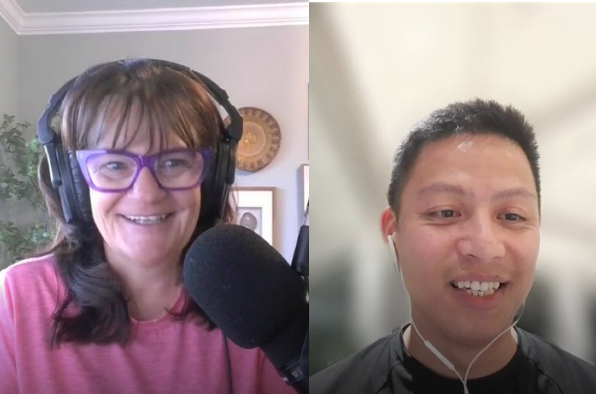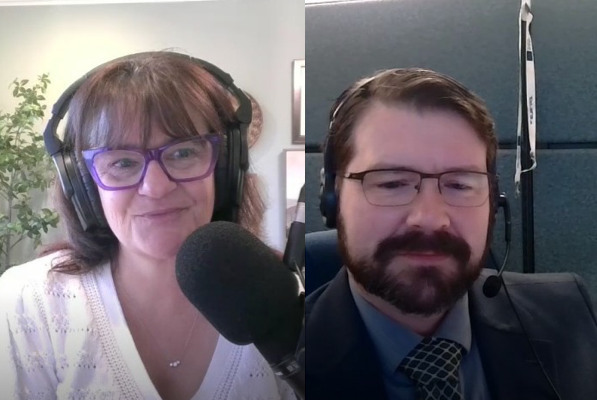
Carl Bogan joins Erin to talk about the evolution of deepfakes — from his pioneering viral video to today’s need to protect businesses and consumers from video impersonation in scams and fraud.
Episode 53: Who knew that creating a deepfake video that merged Will Smith and Cardi B into one person would become a viral success? Who knew that the creator of that video would now be focused on stopping the criminal use of the same technology?
In this episode, Erin West talks with Carl Bogan — the visual effects pioneer who created the original viral deepfake in 2019 and has since seen his invention weaponized at scale. What began as a technical experiment to solve a startup's content problem became a two-decade reckoning with tech that’s now available to anyone with a phone and an internet connection.
Now you can be anybody you want to be. You can be Beyoncé at a concert. You can be skydiving as an alligator. — Carl Bogan on the simplicity of deepfake technology
Carl takes Erin through his early days creating viral celebrity deepfakes as “Mr. Giraffe,” to cracking real-time facial mapping, to authoring a book about protecting businesses from deepfakes, to new risks related to the simplicity of creating convincing deepfakes on smartphones.
Prefer audio? Find Stolen on Apple Podcasts, Spotify, Amazon Music, and other major platforms.
He talks about the evolution of deepfake tech and the detection protocol he’s developed to address the problem. Inject Measure Verify is a deceptively simple, binary approach to authentication using signals in the video code itself. Rather than asking, "How likely is it this video is fake?”, his tech analyzes whether the original signal is present. (Don’t worry if that sounds confusing; he uses baking a cake as an excellent analogy.)
Erin and Carl talk about how deepfakes are part of the scamdemic stories we hear every day. Victims are convinced the FBI is calling. Romance fraud targets who receive calls from celebrities. And they talk about the challenges of a Congress with no true background in or framework for understanding about the technology it’s being asked to regulate.
You don’t give a baby a knife. We’re a bunch of babies running around with knives. — Carl Bogan
Together, they arrive at a sobering conclusion: The technology is out of control, the window to prevent widespread harm is closing, and the near-term defenses rely on human behavior and helping people take the time to evaluate what they’re being asked to do and if the person asking is legitimate.
Scroll down for: Guest Bio - Chapters - Sponsors - More Stolen
5 Key Points about Deepfakes from Carl Bogan
1. The original deepfake is six years old — and already looks primitive. Carl created the first viral deepfake in April 2019, a face-swap of Cardi B onto Will Smith that required meticulous frame-by-frame editing. Today, genAI can produce entire video frames from scratch, making any face, setting, or scenario possible with free software. The barrier to entry has collapsed from specialized hardware to a cell phone.
2. Current deepfake detection strategies aren’t working. Detection technologies have largely focused on probabilistic scoring (“82% likely to be fake”). Carl argues that “maybe” doesn’t solve the problem. His Inject Measure Verify protocol treats the question as binary. It reads the invisible signals in video feeds; if those signals don’t come through on the other side due to manipulation, it flags the video as inauthentic.
3. Confirmation bias is a powerful amplifier. Carl considers political and emotionally charged content as the most dangerous use of deepfake technology. Not because of the tech itself, but because people are predisposed to believe what they want to be true. The combination of high-quality fabricated video and motivated reasoning reinforces beliefs with false information, creating conditions for civil unrest, financial fraud, and political violence.
4. Releasing generative AI to the general public was irresponsible. When Carl was pioneering deepfakes, technical complexity was a de facto safety mechanism. Free tools, cloud computing, and AI-assisted workflows help users impersonate anyone in minutes. Carl draws a direct line from this accessibility to the explosion of investment scams, FBI impersonation, and romance fraud that Erin and Operation Shamrock address daily.
5. The most effective defenses are human. Speed is a scammer's greatest asset. Carl shares practical advice. Take a few extra steps to verify information, especially when someone online is asking you to do something. Use family code words. Hang up on the person making an immediate demand. Don’t let urgency make the decision for you. One deliberate pause can break the entire fraud.
What to Do Next
Learn more. Carl’s book, Behind the AI Mask, covers the history of deepfake technology, how it works, and the Inject Measure Verify protocol he developed to fight it. Written for general readers, it can help you understand what you are actually up against.
Get ahead of the threat. Have a conversation with your family. Set up family codewords. Organizations can bring in a trainer to speak to staff about institutional-level deepfake and fraud risks.
Share this episode. The more people who understand how far this technology has come, the harder it is for scammers to use it against them.
Stay up to date. Subscribe to Stolen and leave a review wherever you listen. Keep up with Erin as she continues to fight the fraud and exploitation that is reshaping daily life.
Who Is Carl Bogan?
Carl Bogan is a creative technologist and author with over 20 years of visual effects experience for studios including Disney, Paramount, Apple, Google, and Sony. He holds a US Patent for image-processing methods and is the creator behind “Myster Giraffe,” a viral deepfake series that reached over 400 million views.
His book, Behind the AI Mask: Protecting Your Business from Deepfakes (Wiley, December 2025), draws on his firsthand experience creating synthetic media to help organizations understand and defend against AI-enabled fraud. Bogan now consults with businesses on synthetic media threats, bringing a rare perspective: someone who built the threats before pivoting to help others defend against them.
Episode Chapters
00:00 Introduction to Carl Bogan
03:48 Creating Viral Deepfakes: The Myster Giraffe Story
06:18 The Early Days of Deepfake
11:44 The Evolution of Deepfake Applications
15:03 Navigating Legalities in Deepfake Technology
16:43 The Secret Deepfake Community
19:22 Exploring the Psychology of Deepfakes
22:18 Concerns About Deepfake Technology
24:53 The Journey to Writing "Behind the AI Mask"
27:12 Innovative Solutions to Combat Deepfakes
31:31 The Simplicity of Detecting Deepfakes
35:55 The Growing Threat of Deepfakes
39:11 Accountability in the Age of Misinformation
45:16 Practical Steps to Combat Scams
Subscribe to Stolen for straight truth, survivor-centered storytelling, and bold conversations about the scamdemic and the people fighting back. Find Stolen on YouTube, Apple Podcasts, Spotify, Amazon Music, and other major podcast platforms.
Sponsors of Stolen

BioCatch prevents financial crime by recognizing patterns in human behavior, continuously collecting 3,000 anonymized data points – keystroke and mouse activity, touch screen behavior, physical device attributes, and more – as people interact with their digital banking platforms. With these inputs, BioCatch's models reveal patterns that distinguish the criminal from the legitimate.

Scamnetic is a leader in AI-powered scam detection and prevention, protecting individuals, businesses, and financial institutions from digital scams. With solutions like KnowScam and IDeveryone, Scamnetic delivers real-time scam insights, identity verification, and intervention. Restoring trust, reducing losses, and empowering organizations to safeguard customers in an increasingly complex digital world.
Recent Episodes of Stolen